Inaturalist--Free app. I was able to use Papua New Guinea as a location. This has the most species listed under explore than any of the other apps. The map of observations was easy to see. This app listed seasonality. The life stage was very useful, for example with the Imperial Fruit Sucking Moth, it showed during the year peak times for the pupa, larva, egg, and adult. At the bottom of the description you can click on more info on iNaturalist.org. It gives more information, but the fact that the information comes from Wikipedia, makes me a bit hesitant in the trustworthiness. It does list references, literature, and external links, which can be helpful if you want to do a deeper dive.
Merlin Bird ID-Free app. You can identify by sound or photo. If you go to explore, adjust filters, chose likely birds, choose location (I choose Papua New Guinea, PG) I was able to see 195 birds likely to be seen today. When you choose the bird you want to review, it will show how common it is, and you can listen to the sounds the bird makes. For the Pacific Black Duck, I could listen to the display, female calls, or male calls and wing sounds. I enjoyed listening to the sounds. It will also show the range as year-round, migration, breeding, or nonbreeding. The Pacific Black Duck is seen year-round, but is rare. If you think you saw the bird, you can click on the button “This is my bird.” Once I got the hang of how to choose an area, I was surprised at all the data.
Picture Insect- This app is free for 7 days. You can choose 1 month or yearly paid subscription. You can choose any city, and I chose Port Moresby, which is the capital of Papua New Guinea. The local Field Guide displayed 11 most common insects, 4 butterflies, 1 spider, and 1 moth. Once you chose the species, you can review basic information, effects, control, observation. There are photos of males and females and describes the predator-prey relationship. I was very interested in the effects. It will describe the effects of the insect on humans and animals. In the Green jumping spider, it showed what may cause an interaction, how to prevent an encounter, and what to do if bitten.
Picture This--This app is free for 7 days. You can chose 1 month or yearly paid subscription. I could chose any city in the world as a location. I chose Port Moresby, which is the capital of Papua New Guinea. I was able to find a plant index. I could look up toxic plants, trees, and flowers. It showed images, facts, basic information, and distribution and identify in which areas it is native, cultured, introduced, or invasive. Many of the plants were cultured. I did find one that was introduced called the Star of Bethlehem. The Yellow alder was shown to be invasive in Papua New Guinea. You can tap to hear scientific names pronounced, tap on names for taxonomic breakdown, and view comparison images of leaf, flower, fruit, and the whole plant.. You can upload a photo for identification. I found this app to be highly useful in a such a diverse area of plants.
PlantNet-This app is free. It encourages participants to be part of a biodiversity citizen science project. I was able to use the location of Papuasia, which refers to the region of the New Guinea Island. There were some beautiful photos that people had taken. Sometimes because of the quality of the photo, the AI was not able to identify the plant. It shows the name of the person taking the photo and the date. There is a validate button if you are able to confirm that the name is correct. You can join a group to collectively share a specific area or interest. There is a menu option to look by family, genus, and species. You can look at the feed to see latest photos uploaded. I was amazed by the number of distinctive plants in this app that I’d never seen before. The Elephant foot yam was my favorite. If you click on the photo, there is a map and below it is the International Union for Conservation of Nature designation for the plant based on extinction risk
Reptile Identifier. This app is free for 3 days, you can chose 1 week, 1 month, or yearly paid subscription. In the premium version, it includes insects, mushrooms, plants, and fish. I was able to use Papua New Guinea as a location. Under the explore tab, I was able to see pictures of reptiles with their species data such as description, identification features, biological characteristics, emergency response, regions, and taxonomy. One of the interesting things I found in the reptile details was that beside the scientific name was the name of the person or people who first described and named the species along with the year, it was first credited. Most seemed to be from the 1800’s but the Rohan’s Gecko was first described in 2016.
Honorable Mention
#1: Birds of New Guinea is a mobile field guide version of Princeton Field Guide by Thane K. Pratt and Bruce M. Beehler. The illustrations are by John C. Anderton and Szabolocs Kokay. There is a free sample available, but you need to download the latest play books app. It will show you 65 pages. There are 779 bird species in Papua New Guinea. It is published by Princeton University Press, it is available as an ebook for 42.35. If you have an iPad or iPhone, there is a Birds in the Hand, LLC available for $34.99 that includes sounds
#2 Protected Area Monitoring app developed by the Tenkile Conservation Alliance. The Tenkile Conservation Alliance is a non-profit organization dedicated to conservation and protection of the biodiversity in Papua New Guinea. The app that allows staff to record observations in the field and allowing for photos and videos. They not only record biodiversity, but also environmental damage, such as illegal logging, and information about villages that they work with.
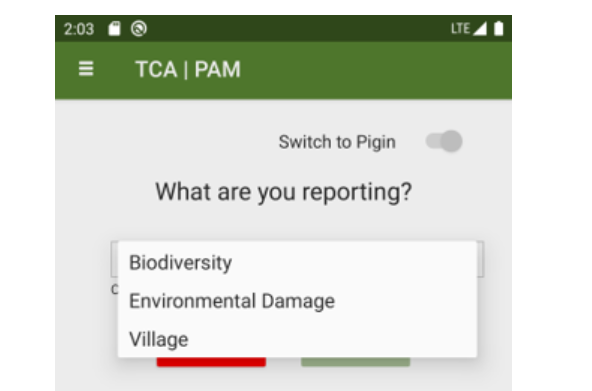
GPS automatically records their location and elevation, so that they do not need to bring paper and pen with them. This app was developed and solely used in-house by the TCA. This app was developed by Rich Blaske from Georgia, US. The app has allowed TCA staff to identify many bird species that they were not able to identify prior.
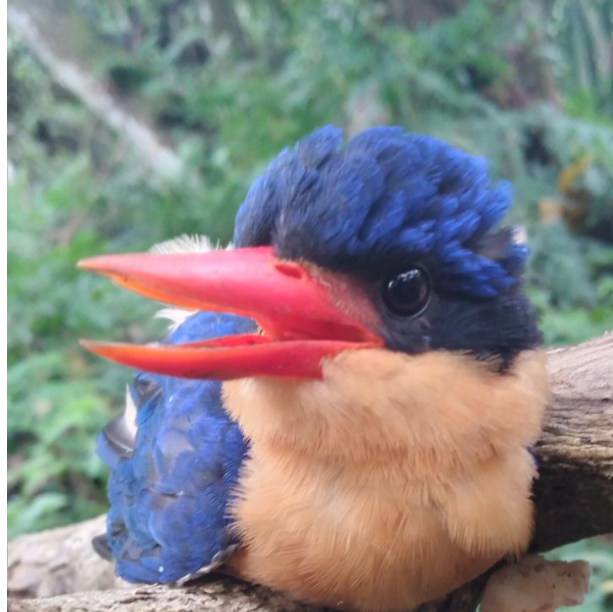
A photo of a buff-breasted paradise kingfisher observed by TCA staff and uploaded to the PAM app. Credit: Tenkile Conservation Alliance.
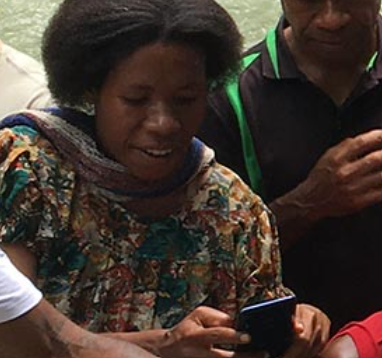
The article in Mongabay, noted that the app has allowed more freedom for the female staff to participate in observations, as prior to the app, the women in this patriarchal society were not able to share freely.
reference: Mukpo, A., DiGirolamo, M., Butler, R. A., Cardona, A. J. P., Gabay, A., Truscott, R., Hasnat, M. A., Mowbray, S., & Raman, S. (2023, February 6). New App Transforms Data Gathering for wildlife in Papua New Guinea. Mongabay Environmental News. https://news.mongabay.com/2022/11/new-app-transforms-data-gathering-for-wildlife-in-papua-new-guinea/ and Biopama. Tenkile Conservation Alliance. (2023, November 9). https://tenkile.com/biopama/
#3 Lukim Gather. This is a phone app developed by Catalpa International. It allows Rangers in Varirata National Park in Port Moresby and Tenkile Conservation Area in Lumi, West Sepik Province working in isolated areas to be able to to record and report harmful activities occurring in Papua New Guinea protected areas using their smart phones. The Conservation and Environmental Protection Authority is automatically notified. The support of the United Nations Development Programme (UNDP) and financial backing from the Global Environment Facility (GEF) has made this CEPA initiative possible.
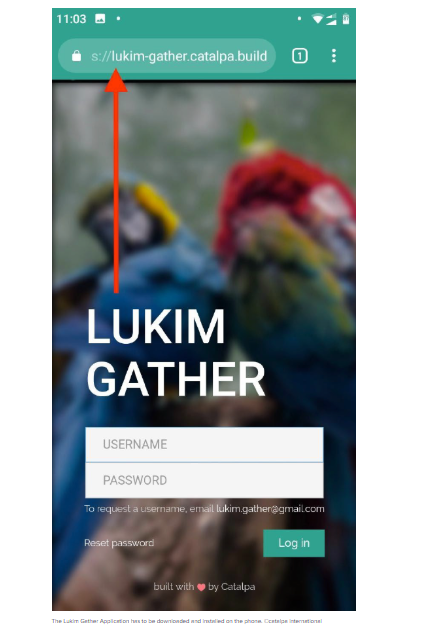
I was able to find the app on Google play.
Reference: Mobile application, a new tracking tool for conservation. UNDP. (2020, January 28). https://www.undp.org/papua-new-guinea/news/mobile-application-new-tracking-tool-conservation